Showing posts with label neuroscience. Show all posts

Monday, December 22, 2014

Change agent: Creating new scans to track brain diseases

Seven weeks after weight-loss surgery, a group of women have seen significant changes in their body shapes and sizes. They’re each down 20 to 30 pounds, but that’s not the only change their bodies are going through.

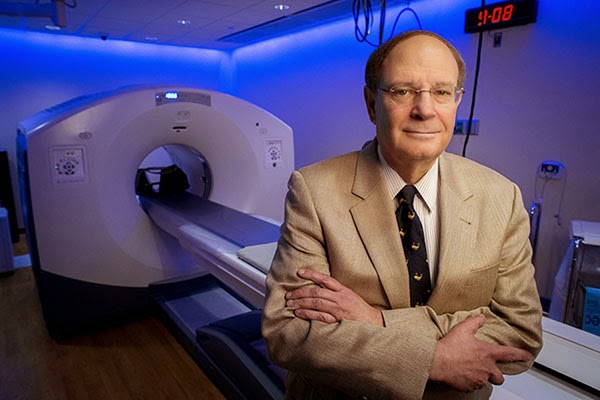
The women’s weight loss is caused by a change in appetite, which results from changes in brain function, explains UAB neuroradiologist Robert Kessler, M.D. (pictured above in UAB's Advanced Imaging Facility). On positron emission tomography (PET) scans, Kessler can see an obvious transformation in the women’s brains, particularly in dopamine neurotransmission.

Using a specialized brain PET scan that he has developed, Kessler can visualize levels of dopamine receptors — molecules that help transmit the brain’s messages of motivation and reward. Before surgery, the women had increased levels of the receptors, which appear on the PET scans as glowing white patches throughout the brain. But after their surgeries, these changes have faded; the women’s brains exhibit a more balanced map of dopamine receptors. In real-world terms, Kessler thinks, these tempered receptor levels reflect a shift to a more normal reward perception, helping the women control their appetites after surgery.

Obesity — and the drive to overeat — isn’t the only pathology that Kessler can see when he peers into people’s brains with a PET scan. During the past 30 years, he has helped illuminate changes to the brain that might underlie schizophrenia, drug addiction, depression and dementia, among other disorders. By looking at a person’s brain PET scan and carefully measuring the levels of neurotransmitter function, Kessler can tell whether someone is more prone to taking risks than average, whether they’re more of a “slacker” or a “go-getter,” and whether or not they have “the ability to experience rewarding stimuli in a normal manner or if they have lost that ability,” he said.

Find out how a cyclotron works, and what makes UAB’s new cyclotron unique among U.S. academic medical centers, in the video above and in this feature from UAB Magazine.
Kessler, who joined the UAB faculty in 2013 as director of neurochemical brain imaging and PET neurotracer development in the Department of Radiology, says these specialized PET scans are paving the way toward a new level of understanding of brain diseases.

“At a very basic scientific level, there’s no other technology that can look at the human brain and inform you about specific molecules and receptors,” Kessler said. At UAB, he’s taking advantage of the university’s TR24 cyclotron — the largest at any U.S. academic medical center — to develop new PET scans. And he has launched collaborations with UAB researchers across the psychiatric and neurological sciences to help them apply his techniques to even more questions.

Focusing on Receptors

As a medical student, resident and fellow in the 1970s, Kessler first became interested in the human brain at a time that clinicians had few methods to visualize the organ. Surgeons could physically see the outer layers of the brain when they opened the skull for an operation, or pathologists could dissect an autopsied brain; but viewing the activity — in a living human — of the molecules that make up the brain’s electrical pathways wasn’t possible.

In 1977, Kessler joined a lab at the National Institutes of Health just as this was changing. One of his mentors there became the first to use a PET scan to visualize the activity of the brain. The earliest scans, rather than pinpointing specific receptors as Kessler does now, were designed to simply show which cells in the brain were undergoing metabolism — a sign of activity — at any given moment.

But the basic idea has been the same for more than three decades now: A patient gets an injection of a radioactive tracer into their bloodstream. Depending on the design of the tracer, it accumulates in particular organs or cells of the body. Then, a PET machine is used to measure the location of the accumulated radioactivity.

“It quickly became clear to me that PET was going to become an important tool for understanding the brain,” Kessler said. “And we began to use it to look at everything from brain tumors and schizophrenia to aging and dementia.”

As Kessler immersed himself in the new technology, first at NIH and then at Vanderbilt University, he helped develop new tracers that would pave the way for the rest of his career: 18F-Fallypride, and later 18F-FPEB. Rather than building up in all metabolizing brain cells, these radioactive molecules bind specifically to dopamine and glutamate receptors.

Among the first questions Kessler asked with 18F-Fallypride was ‘What are the effects of antipsychotic drugs on the brains of patients with schizophrenia?’ A new class of antipsychotic drug had recently been developed; the drugs had fewer side-effects than older versions, but researchers didn’t know why. Kessler and his collaborators discovered that the new drugs targeted different areas of the brain than the old drugs, offering not only an explanation for the differences, but a way to test future drugs for their efficacy.

Dopamine had also already become known as a chemical that mediates reward-seeking behavior and pleasure. So Kessler’s lab began to look at how levels of the dopamine receptor and the effects of dopamine release on dopamine receptors might relate to drug abuse, impulse control, addiction and the ability to feel pleasure.

“People who are depressed lose their ability to enjoy rewards and experience the pleasures of life; people who are addicted have very distorted reward functions where they crave just one reward,” Kessler said. “We showed that dopamine plays a key role in all of these.”

These are 18F-Fallypride PET images of dopamine D2 type receptors, averaged across several normal subjects. There are high levels of these receptors (red color) in deep brain structures and lower levels in the cortex. These include the basal ganglia and thalamus (A), amygdala and temporal cortex (B), and substantia nigra (C). These regions are concerned with movement, emotion and cognition.

The Future of Brain PET

PET scans offer the most direct way to observe what happens at a molecular level in the brain when someone develops, or recovers from, a psychiatric disorder or addiction, Kessler says. Drug developers and pharmaceutical companies now use PET scans to fine-tune prospective new treatments, he notes. If they know they need to lower the number of dopamine receptors in one area of the brain, for instance, they can use PET scans to determine which drugs, and drug dosages, effectively achieve this.

One of the ongoing challenges in the field, Kessler says, is developing new tracers. With UAB’s new cyclotron, Kessler says he has the tools at his fingertips to continue developing and perfecting tracers that bind to different receptors in the brain. He’s already begun work with the neurotransmitter glutamate; like dopamine, glutamate can be studied through PET tracers that bind to glutamate receptors. And glutamate is thought to have roles in autism, Huntington’s disease, Parkinson’s and anxiety disorders, among other things.

This fall, Kessler launched a study examining glutamate receptors in the brains of addicts as they voluntarily withdraw from methamphetamine. The findings — if they show key differences from normal brains — could lead to new drugs to help meth addicts quit their addiction. Studies on Parkinson’s, depression and Alzheimer’s disease are also in the works with UAB collaborators.

Although “this is a tough area to work in for many reasons,” Kessler said — from the vagaries of chemical half-lives to the sheer complexity of the brain itself — he wouldn’t have it any other way. “You just can’t get this kind of information anywhere else.”

Monday, October 15, 2012

UAB team sets sights on neuroprotection

Neurological diseases are notoriously complex, and drugs have not improved significantly in decades. The main drug treatment for Parkinson's disease, L-DOPA, was first approved for use in 1970. It temporarily staves off symptoms but can itself cause heart arrhythmias, stomach bleeding and hallucinations. Patients with Parkinson's die at twice the rate of those without the disease.

For these reasons, researchers have been urgently seeking for years to understand Parkinson's to the point where they can begin to design drugs that go beyond symptom relief to counter the inflammation and nerve cell death at the disease's root. A team of researchers from the University of Alabama at Birmingham gave a presentation today at Neuroscience 2012, the annual meeting of the Society for Neuroscience in New Orleans,  in which they revealed that they may be approaching that point. The researchers have designed a set of experimental drugs called LRRK2 inhibitors that show evidence of protecting nerve cells, at least in the rodent and cell culture studies they have carried out so far, which are meant to approximate human disease.

But these are still just models, and therein lies the problem. Despite the excitement among researchers, when should patients begin to raise their expectations?

The UAB research team, and the field of neurology in general, is excited just to have identified an enzyme like LRRK2 against which they can design drugs that could reverse underlying disease processes. That would be a first for any neurodegenerative disease. Along with evidence that LRRK2 plays a crucial role in the mechanisms of Parkinson’s disease, it is the same kind of enzyme (although not the same one) that has been successfully targeted by existing cancer treatments, including Herceptin. On the other hand, the UAB team's LRRK2 inhibitors are still years away from human clinical trials. They must pass several basic tests (e.g. toxicology tests) before even being considered for human trials, and a great many drug candidates fail at this stage.

Perhaps the best we can do is to set down the facts, and offer just enough hope while avoiding hype.

The Mix sat down with Andrew West, Ph.D., associate professor in the Department of Neurology within the UAB School of Medicine, who gave the presentation today at Neuroscience 2012. We wanted his take on what has been accomplished so far, and on what lies ahead. Also please take a look at our related press release on his meeting presentation.


Show notes for the interview:

1:00 Patients are surprised to hear that there is today no treatment that reverses the underlying disease processes related to Parkinson's disease, and that the focus for decades has been on symptom relief only.

1:37 The other surprise facing newly diagnosed patients is that most of the treatments in use today were developed at least 50 years ago, so it's frustrating for them to learn about how limited their options are.

1:48 Traditionally, researchers have seen the death of nerve cells that make dopamine, the signaling chemical that contributes to our ability to control our movements, as the relentlessly progressive disease process underlying Parkinson's disease. This would explain how the disease, as it gets worse, eventually overwhelms older drugs that seek to relieve symptoms by replacing lost dopamine.

2:07  In recent years, however, the field has learned that although loss of dopaminergic neurons is important, disease processes may well affect pathways beyond dopamine.

2:48 In 2004, population studies found genetic mutations in the gene for an enzymne called LRRK2
in families at greater risk for an inherited form of late onset Parkinson's disease. The mutation most closely associated with the disease makes LRRK2 slightly over-active. The idea is to dial LRRK2 back with drugs.  The question still to be answered is whether or not LRRK2 represents a key controller of Parkinson's severity in all patients with the disease, including those that develop it for reasons unknown in their sixties.   

4:09  While there are still years to go before LRRK2 inhibitors could become available to patients, West says the field is further along in the process of developing a specific target to design drugs against than many Parkinson's researchers ever thought would happen.  

5:05 One of the challenges in neurodegenerative disorders is that humans may be the only creature to get certain diseases of the brain. And yet, to test whether an experimental drug is worthy of human trials, you need to try it first in animal models that mimic the human condition. West says the field is now making progress on creating such models, which may quicken the pace toward human studies. 

6:04  When it comes to developing drugs in the face of stricter regulations, industry and academia have learned in recent years to do more experiments on drug candidates early on, before research teams even apply for permission to start a clinical trial. West's team is repeating its experiments right now to be sure of its data, and to ensure that the team's would-be drug has strong effects in a model that mimics human disease. 

7:17  LRRK2 gets researchers excited because it is rare to find enzymes that are both proven to have a role in a disease of the brain, and that are structured such that a drug can change their action. LRRK2 is the same kind of enzyme (although not the same one) that has been safely and potently targeted by existing treatments for other diseases, including the cancer drugs Herceptin, Tarceva and Erbitux.

8:49 Inherited forms of disease can hide from evolution if they start late in life. They do not keep anyone from reproducing so there is no evolutionary pressure to weed them out of the gene pool.  

10:47 Researchers cannot differentiate between the symptoms of inherited Parkinson's disease linked to a LRRK2 mutation and symptoms in those who develop PD late in life for reasons unknown. That creates at least the possibility that LRRK2 may have a role in all of PD and that a drug fine-tuning LRRK2 could be helpful in all cases. West says he was shocked when it came to light that a disease as complicated as inherited Parkinson's could be caused by a mutation in a single gene.

12:00 Along with whatever is triggering Parkinson's disease, the idea has emerged in the field that the body's reaction to that trigger, the response of the immune system, may be making the disease worse by causing inflammation. LRRK2 may be a critical switch to deciding whether or not inflammation makes the disease worse. 

13:46 Getting a drug into clinical trials today requires a massive investment, so it does not pay to enter clinical trials prematurely. A rushed trial that fails because of poor design can result in a "black eye" for that drug target, making it harder to find funding for related research projects after that.  

15:22 West's team has been working with LRRK2 for several years now, and has been refining  proposed drug candidates that inhibit it. Their latest lead drug candidate overcomes many of the limitations of earlier generations of proposed drugs. It is capable of having its effect in the brain, and targets only LRRK2, and not any of the hundreds of enzymes it might interact with to cause side effects. 

16:32 West recommends that those interested in Parkinson's disease and related research look up the relevant webpage from the National Institute of Neurological Disorders and Stroke. Also very helpful are the websites for the Michael J. Fox Foundation, the Parkinson's Disease Foundation and the American Parkinson's Disease Association.