Monday, September 23, 2013

Image post 9: infection blocks trash removal to cause ulcers, cancer


What's that ... a meteor blazing past a molten planet?  No, it's a self-destructing cell just shed from a gastric gland made up of the tightly packed blue cells running across the bottom.

Gastric glands that secrete digestive juices into the stomach, like all epithelial cells (skin, lining of blood vessels, etc.), constantly shed old cells from their outer layers and replace them with new ones. The turnover keeps tissues viable throughout adult life. When the shed cells sense they have outlived their usefulness, they initiate self-destruct mechanisms.

With some cells always in the process of self-destructing, other nearby cells are charged with swallowing up the dying cells and disposing of them. That explains the red cloud surrounding the yellow dot at the center of the image. An antigen-presenting cell (dyed red) has engulfed a self-destructing cell (yellow) to remove it.

The system works pretty well until a person's stomach gets infected with the bacteria Helicobacter pylori.

The infection causes cells to release TNF-alpha, a signaling chemical that triggers the waves of cell activation and chemical release meant to kill invading bacteria or viruses (inflammation). While the process protects us against infectious disease, it also plays a role in many disease processes when it goes too far.

A recent study by a team of UAB researchers found that, along with triggering inflammation, TNF-alpha also blocks the engulfment and removal of dying cells. Cellular debris builds up to drive further inflammation in a vicious cycle.

Why does this matter?  Inflammation caused by Helicobactor pylori is behind the development of nearly all ulcers. Furthermore, the same chronic inflammation damages DNA, creating risk for hard-to-treat gastric cancer.

The image was created by Diane Bimczok, DVM, Ph.D., an instructor in UAB's Division of Gastroenterology and Hepatology, using routine fluorescence microscopy and digital imaging. Phillip Smith, M.D., was senior author of the related study. 

Thursday, September 19, 2013

Alcohol throws off circadian clock to damage liver

Having evolved to keep time with our planet's rhythms – day and night, light and dark – we are wired at the genetic level to sleep at night and to wake and eat during the day. Research in recent years revealed that genetic and protein feedback loops – or clocks – operate in 24-hour cycles in every human cell. The clocks signal to thousands of genes, many of which speed up our ability to make and use energy from food during the day and turn it down at night.

Bucking those patterns – say by working the night shift – has been shown to increase a person’s risk for heart disease, diabetes, cancer, depression, etc.

In a new twist, Shannon Bailey, Ph.D., associate professor in the Division of Molecular and Cellular Pathology within the UAB School of Medicine, just published a study that found chronic alcohol use may interfere with the genetic clocks in liver cells to accelerate liver damage. Dr. Bailey is a longtime liver disease expert with a new research focus on the role of circadian clocks in alcohol-related liver damage.

We thought to ask her whether too many martinis can throw off molecular clocks and, from a circadian point of view, what the healthiest hour is to drink a glass of wine.


Show notes for the podcast:

1:51 Genes are long chains of molecules that encode instructions for the building of the proteins, the workhorse molecules that make up bodily structures and signals. Interestingly, the process of turning genes into proteins proceeds at a certain rate, so it has become the basis of a system that keeps time like a clock. To achieve a biochemical balance necessary for life, many genes are part of pathways that sense when there enough of any given protein, and sends signals to shut down the building process: so-called feedback loops. The twenty or so genes and proteins that make up the human circadian clock happen to perform these loops in a roughly 24-hour cycle, and so evolution favored them. Creatures that happened to align their metabolism to these clocks became one with their environment and were more likely to survive. Thus, the cells making up most life on earth today -- bacteria, plants, animals, etc. -- include genetic clocks.

3:44 In a larger sense, the clocks show the ability of genes to adjust their action in the face of changing environment. Genetic changes in energy use also occur after meals whenever they occur, and during the flight or fight response.

4:35 One of the functions of the circadian clocks in every human cell type is to turn off metabolic pathways that produce cellular energy from food when we don't need them. While obviously vital to life, highly active metabolic pathways create byproducts like free radicals that tear apart sensitive cell components and cause cells to self-destruct as part of many diseases, including major ones related to energetics: diabetes and heart disease. Shutting them down at night may help us to live longer.  

5:33  A major focus of Dr. Bailey's research is the mitochondria, sub-compartments of human cells that convert sugar from food into cellular energy by using oxygen.  She is especially interested in the role of mitochondria in liver disease. Overproduction of free radicals by mitochondria in liver cells damages other parts of the same cells, and shutting down these pathways at night may give cells a chance to repair the damage. A key emerging question is how not circadian clock genes in the nuclei of liver cells signal to mitochondria to control energy production.

6:39  While most studies look at the effect of staying up at night on circadian biology, Dr. Bailey wanted to look at the effect of alcohol on circadian clocks. Some of her interest stems from the fact that neuroscientists have been exploring in recent years whether or not circadian clocks in nerve cells in the brain may contribute to the forming of addictions. Up until the current study, only a few studies had looked at the effect of alcohol consumption on peripheral cells (gut, heart, liver, etc.). It's really starting to take off, says Dr. Gohlke.

8:43 As whole, the body’s circadian clock is regulated by a part of the brain called the suprachiasmatic nucleus, which drives daily physiological and behavioral rhythms. The newest frontier, embodied by Dr. Bailey’s study, is the effort to understand the role of the circadian clock in each cell type, and what happens when the cell-specific clocks are out of sync with the central clock in the brain. The liver is the organ in the body most responsible for regulating system-wide energy needs and is charged with holding steady levels of sugar supplied to cells by the bloodstream. Studies have shown that molecular clocks in the liver help keep the blood sugar level constant as we eat and fast, sleep and wake., largely through adjusting levels of the hormone insulin. If we throw the clocks off, we throw our blood sugar off and contribute to the development of diabetes.

9:54  The liver also plays a prominent role in the amount of cholesterol and fat in the blood, as well as the breakdown of drugs in the bloodstream.  Should the clocks be shown to regulate those pathways and alcohol affects them, then chronic drinking hardens arteries, the leading cause of heart attacks and strokes, and contributes to obesity.

10:32 To study the effect of alcohol on circadian clocks, Dr. Bailey and her team separated mice into two groups, one that received a healthy diet, and a second that had the same diet plus a steady supply of alcohol (ethanol). They then collected brain and liver samples for both mice to look for changes in clock genes patterns. They found that expression of metabolic genes that normally up and down  in 24 hours cycles no longer do so with chronic alcohol use. It also looked like metabolic pathways that normally operate in sync became disjointed.

13:35 In a healthy individual, certain clock genes in liver cells are expressed three hours after the same genes are expressed in the brain. One theory holds that the time lapse is a temporal signal between the systems that monitor how much energy we need, and those that supply the right amount of energy in response.  If alcohol throws off the liver cell clocks, they may no longer proceed in sync with the brain clock. Such a loss of synchrony represents a potential disease mechanism in heart disease, diabetes and obesity.

15:56 Fatty liver disease, which is very common in the United States, is the earliest stage in the progression toward much more serious liver diseases like cirrhosis. It is also seen people in pre-diabetes or obesity. Healthy people store their fat in their fat cells, their adipose tissue, and not their liver cells. Dr. Bailey is interested in whether or not disruption of liver clocks contributes to this build up of fat in liver cells.

17:31 As the understanding of molecular clocks grows, researchers will seek to influences parts of the clock that contribute to disease. Research teams have already shown that some drugs, at least in animal models, can fine-tune clocks to counter weight gain. Dr. Baily is looking forward to testing whether such drugs can counter the contribution of clock genes, under the action of alcohol, to liver damage

18:03 Dr. Bailey's study did look at whether the expression of proteins that break down alcohol fluctuate with time of day, but not at how active those proteins are. She has proposed a series of studies that will seek to determine what time of day is best for that glass of wine. The studies so far at least suggest that there may be times of day when the liver is more or less vulnerable to the toxic effects of alcohol.

Monday, September 2, 2013

Mechatronics: from minivans that predict crashes to unmanned battlefield rovers

Remember the Subaru ad about how its cars "transfer power from the wheels that slip to the wheels that grip"?  Behind and beyond that jingle is an emerging field of engineering described by technical terms like mechatronics and agile vehicle dynamics.

Foxhound Vehicle. Courtesy UK Ministry of Defense.
The field seeks to design intelligent vehicles that adjust power distribution to the wheels, suspension stiffness and traction control with extreme speed in the face of changing road conditions. When perfected, such "agile" vehicles will make proactive decisions to avert crashes as the wheels begin to spin.

Systems that transfer power to the gripping wheels are also a must for vehicles meant to operate on loose soil for farming, construction, emergencies or military operations. Agile, unmanned vehicles, for instance, will soon negotiate the chaotic terrain of battlefields and disaster zones, making their own decisions while climbing out of ravines or driving over downed power poles.

We thought to talk with Vladimir Vantsevich, Ph.D., a specialist in vehicle design, as he gets set to host the UAB “agile vehicle” symposium Sept. 8-11, 2013, at the Hilton Birmingham Perimeter Park Hotel. The event will be the first to assemble experts in the specialty from around the world, and it will explore ground vehicle dynamics, energy efficiency and performance in severe environments.


Show notes for the podcast: 

1:17 Dr. Vantsevich earned his Ph.D. and Sc.D., the highest degree in the former U.S.S.R., from Belarusian National Technical University. Belarus is an independent country and home to several automotive design companies. In 1997, he received an assignment to work the deputy permanent representative from Belarus to as for the United Nations, where for the years he worked on issues related to the protection of intellectual property rights as part of the U.N. Commission on Science and Technology. After three and a half years there, he took a facutly position at Lawrence Technical University in Michigan, where he built automotive engineering programs for 11 years, before coming to UAB a year ago.

2:10  Dr. Vantsevich is a pioneer in the design of systems that distribute power between the wheels. What may seem like a technical detail has everything to with the ability of a passenger car to achieve traction on a wet road, not to mention its fuel efficiency

3:33 Dr. Vantsevich holds 30 certified inventions and is well known in the American Society of Mechanical Engineering, with most of his innovations concerned with slip differentials. A differential is a set of gears that enable wheels to rotate at different speeds as the engine applies power to them and as road conditions vary. When a car turns for instance, the wheel travelling around the outside of the turn must roll farther and faster than its counterpart on the inside. A limited slip differential is a gear arrangement that, in an off-road environment, senses when one wheel if off of the ground or has hit a patch of ice and transfers power to the wheels still in contact with the ground.

6:30 Alabama's reputation is growing internationally as a center for automotive engineering, and now is a great time to gather leaders in Birmingham to decide on next steps for the field. The symposium promises to have a positive impact on UAB and local automotive companies as well, potentially helping them to recruit talent to the area, Dr. Vantsevich said.

8:58 The symposium also focuses on dynamics, the study of what happens when you apply forces to a moving body, say a vehicle. What happens to a car when you combine the forces transmitted by the engine to the wheels with those applied by the wheels to the ground combined with a strong side wind?

12:14 Many ads about luxury cars talk about the "active safety features" available in new cars today.  Your car might issue a warning if you attempt to change lanes into space already occupied by another car.  It might tell you if you're about to back out of parking space into an oncoming car. Despite these wonders, there is still tremendous potential to improve these systems, Dr. Vantsevich said. To realize their potential will require researchers to develop theoretical and analytic foundations, the agile dynamic underpinnings of future systems. The symposium in Birmingham will launch some of those efforts.

14:48 There also may be value in creating unmanned vehicles that are autonomous, with no need for remote control as they go about their mission and stream intel back to headquarters. Such "ground drones" may save many soldiers lives, but only if they are capable of negotiating extreme terrain. If their mission requires them travel long distances, such vehicles must also be fuel efficient, and especially in the case of autonomous rovers deployed to the surface of Mars.

16:52  Furthermore, such unmanned vehicles would often have a "mission-related payload," like a robotic arm on top. Experts in mechatronics would have to consider how the weight and motion of the arm changed the agile vehicle dynamics and performance.as a rover drove up a steep slope.

18:54 While cars started out as mechanical systems, like wind up clocks based gears and mechanisms but no electricity, they have become something else, said Dr. Vantsevich. Cars today might have five computers, which is more than the space shuttle had. The interplay between mechanical, computer and electrical systems of any device, from a smart phone to a car, is the province of mechatronics. It's not just a combination of separate mechanical, electronic and computer systems, but an approach where different sets of physics become one.

23:55 In recent years, car designers have added many electronic devices to cars in seeking to improve their performance and fuel efficiency. An unintended result is that today's car has two kilometers of wires running though it that together weigh 30 kilograms. That weight that costs the car in fuel efficiency and handling, and mechatronics-minded engineers are seeking to reduce that burden.

28:02 Dr. Vantsevich seeks to develop a world class program in mechatronics at UAB, which will include courses at the bachelor's, master's and Ph.D. level. Newly offered courses include "introduction to mechatronics, design of robots and design of hybrid vehicles, the latter in partnership with The Southern Company. As electricity producers, power companies like The Southern Company have taken an interest in charging stations for electric cars and in the cars themselves.

29:07  The symposium starts on Sept. 8 and is formally titled The Agile Ground Vehicle Dynamics Energy Efficiency and Performance in Severe Environments International Engineering Symposium. It will be hosted by the UAB School of Engineering and Department of Mechanical Engineering, Barber Motorsports, Southern Company, the Birmingham Chapter of American Society of Mechanical Engineers and the International Society for Terrain Vehicle Systems.
                                                    
Speakers will include:
Other symposium participants will include Ford Motor Company, General Motors, John Deere and Volvo.
Conference registration is $250 for students and professionals from developing countries, $550 for professionals and $750 for exhibitors. Registration discounts are available to local companies and academic institutions. UAB students, faculty and staff may attend workshops at no cost, but must pay to attend the banquet. For more information, contact Dr. Vantsevich at vantsevi@uab.edu or 205-975-5855.

Wednesday, August 21, 2013

Image post 8: mapping live brains

This image from UAB Research illustrates the improving brain maps that promise to reveal the mechanisms behind complex, neurological diseases.


A MRI technology called diffusion tractography captured this image of a living rat brain. Tractography is a 3-D modeling technique that visually represents nerve pathways in the brain using data collected by diffusion tensor imaging (DTI).

DTI visualizes nerve pathways known collectively as white matter that connect the various parts of the brain via long bundles of nerve cells. It shows whether or not bundles of white matter fibers run in the same direction, but not in which direction. Tractography does that.

Since developed by researchers at Washington University School of Medicine in St. Louis, it has given the field a more detailed look at brain structures, especially living brains. Taken together, these new MRI technologies promise to improve understanding of neurological disorders like schizophrenia and Alzheimer's disease and the consequences of head trauma. They also may one day help neurosurgeons better avoid cutting nerves during surgeries.

In particular, tractography reveals connections that can be measured in living human subjects and measurements that can be made simultaneously across the entire brain. The Human Connectome Project is capitalizing on these strengths to build more accurate brain maps. The image was created in the lab of Hyunki Kim, Ph.D., associate professor in the departments of Radiology and Biomedical Engineering and faculty in the UAB Comprehensive Cancer Center.

Monday, August 12, 2013

Scratch-and-Sniff test for Parkinson's disease

Many of us grew up with iconic scratch-and-sniff technology. Maybe kids in your class had stickers that smelled like berries or popcorn when scratched. Mom's fashion magazine offered pungent samples of the latest perfume. According to its Wikipedia entry, everything from Nintendo video game packaging to a smell guide promoting the movie Spy Kids to Katy Perry's album Teenage Dream (cotton candy) have featured micro-fragrance coatings. Apparently, 3M came up with it by accident in the '60s during experiments on a copying technology.

Given the technology's pop-culture history, I was surprised to read a recent story in the Birmingham News that it is now being used to test people for early signs of Parkinson's disease. The story features video of David Standaert, M.D., Ph.D., chair of the Department of Neurology within the UAB School of Medicine, demonstrating the test. We asked him to talk about the science behind the test, as well as his team's involvement in a related study funded by the Michael J. Fox Foundation.


Show notes from the podcast: 

1:15 While the credit for the discovery of microfragrance coatings goes to 3M, it was the University of Pennsylvania that spent years developing the standard, scientific method for testing a person's ability to smell. Penn researchers must have had their reasons for including in the test certain smells -- dill pickle, grass, smoke, peach, turpentine, etc. -- but an explanation will have to wait for another post.

1:51 Researchers have known for years that people with Parkinson's disease lose their ability to smell, but not why. Neither did anyone make a connection between scratch-and-sniff technology and Parkinson's diagnosis for many years. Researchers first noticed the change because Parkinson's patients typically lose weight. Without the ability to smell, food loses it taste.

2:23  Old theories had it that Parkinson's disease, by interfering with muscle movement, meant that patients could not sniff as well. That idea was debunked by the work of German neuroanatomist Dr. Heiko Braak in 2003. His painstaking study revealed that among the first brain regions damaged as Parkinson's disease develops is the olfactory center.

4:07. People also lose their sense of smell after head trauma or exposure to harsh chemicals. This led to the major questions in the field like "what does it mean to lose your sense of smell?" and "can smell tests accurately reveal a change in the brain that points to pre-symptomatic, Parkinson's?" If you take a group of people who have lost the ability to smell and follow them through the years, what does that reveal?

4:40  The classic indicator that someone has Parkinson's disease is that their limbs begin to shake (tremor). In recent years it became clear that such a person's dopamine neurons have already lost about 70 percent of their function. An earlier warning sign is a must.

5:05 The damage of caused by Parkinson's to dopamine neurons probably starts a decade before hands start to tremble. Researchers once that the death of such nerve cells was the first thing to happen in the disease process, but not believe it happens in the middle.

6:10 So what happens first? Over the years, researchers had noted that people who would later go on to develop Parkinson's disease first suffered from a strange group of symptoms: sleeplessness, constipation and of course, loss of the ability to smell. With these symptoms so disparate, researchers did not realize for many years that they are influenced by buildup of the same protein, called alpha-synuclein, in the nervous systems of Parkinson's patients.

6:46 Those taking the Parkinson's sniff tests scratch a series of smell pads and answer questions about what they smell. Dr. Standaert's team tests people over 60 years of age, with thee expectation that about a third of them, if they have a sufficiently abnormal sense of smell based on a standard numerical score, will turn out to be in the early stages of Parkinson's disease. So if you are over 60 and can no longer smell normally, you have 66 percent chance of not having Parkinson's and a 33 percent chance of having it (up from 1 or 2 percent risk for the general population).

8:15 Another major thrust of the team's work is to study how nerve cells and nerve pathways that employ the major signaling chemical dopamine to pass on messages are different in people who have lost their sense of smell due to Parkinson's disease. It if turns out that people with with smell loss have a corresponding drop in dopamine function, the team will follow them over several years in hopes of revealing further details on early disease-causing mechanisms in Parkinson's disease.

11:00 Many labs are rigorously pursuing experimental drugs meant to slow the progression of Parkinson's disease. Should one or more of them be approved for use in the relatively near future, one can envision the creation of smell test screening programs for everyone as they turn 60. Those that do poorly, would then be referred for further testing, and preventive treatment could begin much earlier. In terms of a public health intervention, it would be relatively low cost because you could mass mail the sniff test cards with return postage, and people could mail them back in.

Those interested in more information or in participating in future trials should look up the Parkinson’s Progression Marker Initiative, or the Michael J. Fox Foundation survey. Those interested in local trials in Birmingham call also email Stephanie Guthrie at slguth@uab.edu.


Monday, July 29, 2013

Advice for scientists from a Nobel Prize winner

The UAB School of Medicine recently played host to its leading regional forum, the Spring Immunology Symposium. Proof of the event's growing influence can be seen in  this year's keynote, Nobel Prize Laureate Rolf Zinkernagel, M.D., Ph.D., Professor in the Institute of Experimental Immunology at the University of Zurich. Dr. Zinkernagel won in his Nobel prize in 1996 for discoveries that helped to explain how the human immune system recognizes that one of its cells has been infected by a virus.

Included here is a brief video of Dr. Zinkernagel talking about his life's work, what young scientists should be thinking about and frontiers in immunology.


Dr. Rolf Zinkernagel, UAB Immunology Symposium, June 2013 from UAB School of Medicine on Vimeo.

Below is a summary of the video discussion in a Q&A format.

Q1. What should young people keep in mind who want to get into science and immunology?
  • Success requires a scientist to be prepared for a ratio of 1 percent success to 99 percent failure and that a researcher perservere. 
  • Young scientists should be prepared to work long hours because "the harder you work the luckier you get,"  
  • It is important to find a research subject that you feel is extremely important and one where you burn to know the answer.  
Q2. What were the key decisions that led you to success in your field?
  • Among Dr. Zinkernagel's important early decisions as a scientist was to first become a medical doctor. It enabled him to learn study a complex bodily system, the immune system, in its entirety as a foundation. 
  • Dr. Zinkernagel started as a surgeon, but then got interested in immunology because of the immune rejections seen with transplanted organs. His focus remained on infectious disease from there on out, and not entirely by design.
Q3. What are your thoughts about how science differs around the word (e.g. in the U.S. versus Europe)?
  • The United States, and the UK as well, treat research like a sport in some ways, with a spirit of "fierce, competitive openness" that gives new researchers an opportunity to show what they can do, and with relatively few restrictions. Of his native Switzerland, Dr. Zinkernagel said it has a good research environment, but its small size limits opportunities when compared to larger nations. 
  • He also lauded the opportunistic outlook of the average American. That becomes important as researchers face seemingly unsolvable science problems, but just keep trying. 
Q4. What will the future of immunology look like?
  • The next few years will see scientists gain a more and more detailed understanding of the processes and pathways involved in the immune system. He said that the field may go so deep that it identities a set of uniform processes because, at the root of everything, cells are cells despite their different functions.  
  • That said, how cells and organs interact, the province of systems biology, still has a long way to go before researchers understand the sum of complex interactions that result in health or disease.
  • In addition, immunology is a relatively "soft" science compared to physics, said Dr. Zinkernagel. There are yet many unknowns and presumptions that persist despite a lack of evidence to back them up, and many will turn out to be wrong. In that light, those involved in teaching the next generation of immunologists should take care to instill a combination of open-mindedness and critical thinking in their students.   
For a look back, here is another video created by Nobelprize.org after Dr. Zinkernagel won his award.

Friday, July 26, 2013

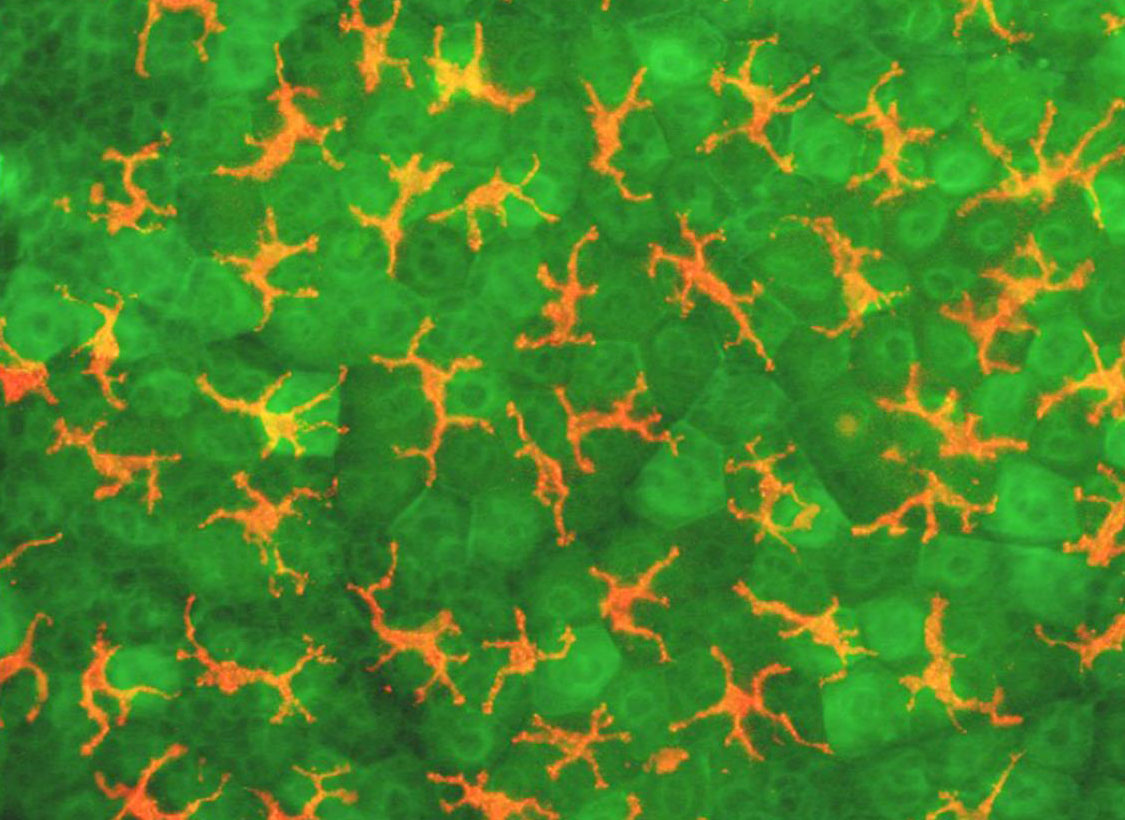
Image post 7: spectacular skin cells

Another interesting image coming from UAB research captures the skin's ability to turn back the sea of microbes surrounding it.   


Pictured here is an outer cell layer of mouse skin. Humans have something similar. The tough, fibrous protein keratin, which gives structure to skin, has been dyed green, and T cells that watch for viruses, bacteria or parasites seeking to invade the body have been dyed orange.

These particular T cells, called gamma delta T cells, are unique in their spectacular appearance. They have been described as a missing link between the more primitive innate immune system, which is quickly, directly activated by foreign invaders, and the slower but more precise adaptive system, which must first be first primed by precise mechanisms before it can unleash clonal cell armies specific to the invader at hand.

Gamma delta T cells do a bit of both, and researchers seek to better understand how they defend the skin from invading microbes and help heal wounds. The image was generated in the lab of John Kearney, Ph.D., professor in the Department of Microbiology within the UAB School of Medicine.