Wednesday, August 21, 2013

Image post 8: mapping live brains

This image from UAB Research illustrates the improving brain maps that promise to reveal the mechanisms behind complex, neurological diseases.


A MRI technology called diffusion tractography captured this image of a living rat brain. Tractography is a 3-D modeling technique that visually represents nerve pathways in the brain using data collected by diffusion tensor imaging (DTI).

DTI visualizes nerve pathways known collectively as white matter that connect the various parts of the brain via long bundles of nerve cells. It shows whether or not bundles of white matter fibers run in the same direction, but not in which direction. Tractography does that.

Since developed by researchers at Washington University School of Medicine in St. Louis, it has given the field a more detailed look at brain structures, especially living brains. Taken together, these new MRI technologies promise to improve understanding of neurological disorders like schizophrenia and Alzheimer's disease and the consequences of head trauma. They also may one day help neurosurgeons better avoid cutting nerves during surgeries.

In particular, tractography reveals connections that can be measured in living human subjects and measurements that can be made simultaneously across the entire brain. The Human Connectome Project is capitalizing on these strengths to build more accurate brain maps. The image was created in the lab of Hyunki Kim, Ph.D., associate professor in the departments of Radiology and Biomedical Engineering and faculty in the UAB Comprehensive Cancer Center.

Monday, August 12, 2013

Scratch-and-Sniff test for Parkinson's disease

Many of us grew up with iconic scratch-and-sniff technology. Maybe kids in your class had stickers that smelled like berries or popcorn when scratched. Mom's fashion magazine offered pungent samples of the latest perfume. According to its Wikipedia entry, everything from Nintendo video game packaging to a smell guide promoting the movie Spy Kids to Katy Perry's album Teenage Dream (cotton candy) have featured micro-fragrance coatings. Apparently, 3M came up with it by accident in the '60s during experiments on a copying technology.

Given the technology's pop-culture history, I was surprised to read a recent story in the Birmingham News that it is now being used to test people for early signs of Parkinson's disease. The story features video of David Standaert, M.D., Ph.D., chair of the Department of Neurology within the UAB School of Medicine, demonstrating the test. We asked him to talk about the science behind the test, as well as his team's involvement in a related study funded by the Michael J. Fox Foundation.


Show notes from the podcast: 

1:15 While the credit for the discovery of microfragrance coatings goes to 3M, it was the University of Pennsylvania that spent years developing the standard, scientific method for testing a person's ability to smell. Penn researchers must have had their reasons for including in the test certain smells -- dill pickle, grass, smoke, peach, turpentine, etc. -- but an explanation will have to wait for another post.

1:51 Researchers have known for years that people with Parkinson's disease lose their ability to smell, but not why. Neither did anyone make a connection between scratch-and-sniff technology and Parkinson's diagnosis for many years. Researchers first noticed the change because Parkinson's patients typically lose weight. Without the ability to smell, food loses it taste.

2:23  Old theories had it that Parkinson's disease, by interfering with muscle movement, meant that patients could not sniff as well. That idea was debunked by the work of German neuroanatomist Dr. Heiko Braak in 2003. His painstaking study revealed that among the first brain regions damaged as Parkinson's disease develops is the olfactory center.

4:07. People also lose their sense of smell after head trauma or exposure to harsh chemicals. This led to the major questions in the field like "what does it mean to lose your sense of smell?" and "can smell tests accurately reveal a change in the brain that points to pre-symptomatic, Parkinson's?" If you take a group of people who have lost the ability to smell and follow them through the years, what does that reveal?

4:40  The classic indicator that someone has Parkinson's disease is that their limbs begin to shake (tremor). In recent years it became clear that such a person's dopamine neurons have already lost about 70 percent of their function. An earlier warning sign is a must.

5:05 The damage of caused by Parkinson's to dopamine neurons probably starts a decade before hands start to tremble. Researchers once that the death of such nerve cells was the first thing to happen in the disease process, but not believe it happens in the middle.

6:10 So what happens first? Over the years, researchers had noted that people who would later go on to develop Parkinson's disease first suffered from a strange group of symptoms: sleeplessness, constipation and of course, loss of the ability to smell. With these symptoms so disparate, researchers did not realize for many years that they are influenced by buildup of the same protein, called alpha-synuclein, in the nervous systems of Parkinson's patients.

6:46 Those taking the Parkinson's sniff tests scratch a series of smell pads and answer questions about what they smell. Dr. Standaert's team tests people over 60 years of age, with thee expectation that about a third of them, if they have a sufficiently abnormal sense of smell based on a standard numerical score, will turn out to be in the early stages of Parkinson's disease. So if you are over 60 and can no longer smell normally, you have 66 percent chance of not having Parkinson's and a 33 percent chance of having it (up from 1 or 2 percent risk for the general population).

8:15 Another major thrust of the team's work is to study how nerve cells and nerve pathways that employ the major signaling chemical dopamine to pass on messages are different in people who have lost their sense of smell due to Parkinson's disease. It if turns out that people with with smell loss have a corresponding drop in dopamine function, the team will follow them over several years in hopes of revealing further details on early disease-causing mechanisms in Parkinson's disease.

11:00 Many labs are rigorously pursuing experimental drugs meant to slow the progression of Parkinson's disease. Should one or more of them be approved for use in the relatively near future, one can envision the creation of smell test screening programs for everyone as they turn 60. Those that do poorly, would then be referred for further testing, and preventive treatment could begin much earlier. In terms of a public health intervention, it would be relatively low cost because you could mass mail the sniff test cards with return postage, and people could mail them back in.

Those interested in more information or in participating in future trials should look up the Parkinson’s Progression Marker Initiative, or the Michael J. Fox Foundation survey. Those interested in local trials in Birmingham call also email Stephanie Guthrie at slguth@uab.edu.


Monday, July 29, 2013

Advice for scientists from a Nobel Prize winner

The UAB School of Medicine recently played host to its leading regional forum, the Spring Immunology Symposium. Proof of the event's growing influence can be seen in  this year's keynote, Nobel Prize Laureate Rolf Zinkernagel, M.D., Ph.D., Professor in the Institute of Experimental Immunology at the University of Zurich. Dr. Zinkernagel won in his Nobel prize in 1996 for discoveries that helped to explain how the human immune system recognizes that one of its cells has been infected by a virus.

Included here is a brief video of Dr. Zinkernagel talking about his life's work, what young scientists should be thinking about and frontiers in immunology.


Dr. Rolf Zinkernagel, UAB Immunology Symposium, June 2013 from UAB School of Medicine on Vimeo.

Below is a summary of the video discussion in a Q&A format.

Q1. What should young people keep in mind who want to get into science and immunology?
  • Success requires a scientist to be prepared for a ratio of 1 percent success to 99 percent failure and that a researcher perservere. 
  • Young scientists should be prepared to work long hours because "the harder you work the luckier you get,"  
  • It is important to find a research subject that you feel is extremely important and one where you burn to know the answer.  
Q2. What were the key decisions that led you to success in your field?
  • Among Dr. Zinkernagel's important early decisions as a scientist was to first become a medical doctor. It enabled him to learn study a complex bodily system, the immune system, in its entirety as a foundation. 
  • Dr. Zinkernagel started as a surgeon, but then got interested in immunology because of the immune rejections seen with transplanted organs. His focus remained on infectious disease from there on out, and not entirely by design.
Q3. What are your thoughts about how science differs around the word (e.g. in the U.S. versus Europe)?
  • The United States, and the UK as well, treat research like a sport in some ways, with a spirit of "fierce, competitive openness" that gives new researchers an opportunity to show what they can do, and with relatively few restrictions. Of his native Switzerland, Dr. Zinkernagel said it has a good research environment, but its small size limits opportunities when compared to larger nations. 
  • He also lauded the opportunistic outlook of the average American. That becomes important as researchers face seemingly unsolvable science problems, but just keep trying. 
Q4. What will the future of immunology look like?
  • The next few years will see scientists gain a more and more detailed understanding of the processes and pathways involved in the immune system. He said that the field may go so deep that it identities a set of uniform processes because, at the root of everything, cells are cells despite their different functions.  
  • That said, how cells and organs interact, the province of systems biology, still has a long way to go before researchers understand the sum of complex interactions that result in health or disease.
  • In addition, immunology is a relatively "soft" science compared to physics, said Dr. Zinkernagel. There are yet many unknowns and presumptions that persist despite a lack of evidence to back them up, and many will turn out to be wrong. In that light, those involved in teaching the next generation of immunologists should take care to instill a combination of open-mindedness and critical thinking in their students.   
For a look back, here is another video created by Nobelprize.org after Dr. Zinkernagel won his award.

Friday, July 26, 2013

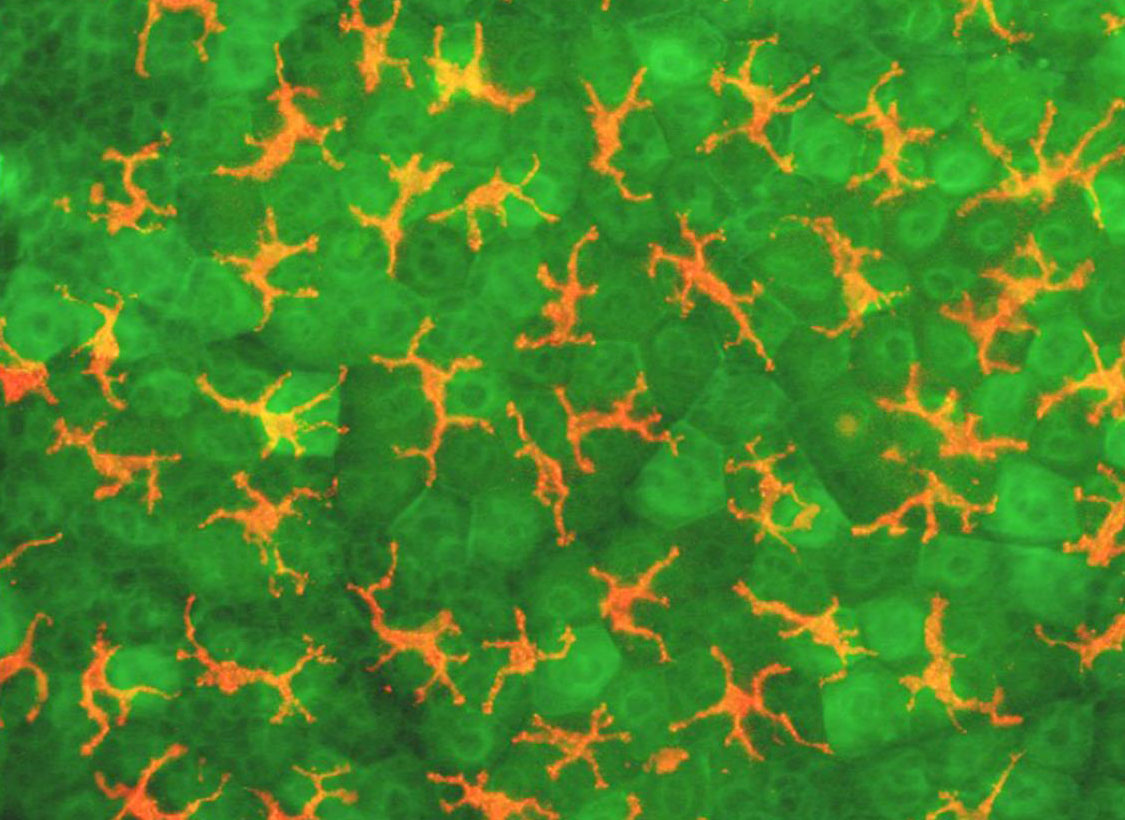
Image post 7: spectacular skin cells

Another interesting image coming from UAB research captures the skin's ability to turn back the sea of microbes surrounding it.   


Pictured here is an outer cell layer of mouse skin. Humans have something similar. The tough, fibrous protein keratin, which gives structure to skin, has been dyed green, and T cells that watch for viruses, bacteria or parasites seeking to invade the body have been dyed orange.

These particular T cells, called gamma delta T cells, are unique in their spectacular appearance. They have been described as a missing link between the more primitive innate immune system, which is quickly, directly activated by foreign invaders, and the slower but more precise adaptive system, which must first be first primed by precise mechanisms before it can unleash clonal cell armies specific to the invader at hand.

Gamma delta T cells do a bit of both, and researchers seek to better understand how they defend the skin from invading microbes and help heal wounds. The image was generated in the lab of John Kearney, Ph.D., professor in the Department of Microbiology within the UAB School of Medicine.

Tuesday, July 23, 2013

Food fungus worsens African AIDS epidemic

I keep coming across factors that, while not directly related to the nature of the human immunodeficiency virus (HIV), are nonetheless driving the African AIDS epidemic.

Take the recent news about a study from the School of Public Health, which found that a type of fungus coating much of the stored corn, rice and nuts in many African and Asian countries may be weakening immune systems and encouraging HIV infection.

Kept in sacks piled in warehouses, food stores in countries near the equator are often contaminated by Aspergillus flavus and A. parasiticus, fungi that produce a toxic substance called aflatoxin.

About 4.5 billion people worldwide are exposed to aflatoxin at unsafe levels, and chronic exposure has been linked to liver damage and related cancers.

Work by Pauline Jolly, Ph.D., professor in the Department of Epidemiology within the UAB School of Public Health, argues that aflatoxin exposure may be taking an even greater toll in areas where millions are infected with HIV. The research team divided 314 HIV-positive people from Kamasi, Ghana, into four groups based on their level of aflatoxin exposure.  The team found that those in the highest exposure group were 2.6 times more likely to have a high HIV viral load than those in the lowest exposure group. Higher viral load translates into higher rates of HIV transmission. For information, please see our news release and related coverage by the New York Times.

Along the lines of non-viral factors worsening the AIDS epidemic was another study published this past August, also from the School of Public Health. Janet Turan, Ph.D., associate professor in the Department of Health Care Organization and Policy, and her team found that the fear of being labeled HIV-positive was strong enough to keep mothers from Kenya from having their babies in health-care facilities. Communities there have come to see clinics and skilled care as mostly for HIV-positive women, and HIV often is linked to promiscuity in the eyes of a woman's family.

In Nyanza, Kenya, a region where one in five pregnant women is HIV-positive, skilled care during pregnancy and birth increases the likelihood that those infected will receive antiretroviral drugs that prevent the passing of HIV from mother to child.

It just seems like Africa can’t get a break.

More troubling yet, the search for solutions to the epidemic's many contributors is not accelerating in the age of research budget cuts. The grants that paid for Jolly's research into the aflatoxin and HIV have ended, leaving her unable to pay for a full data analysis of the consequences of combination exposure on sets of immune cells. She does not know where her next round of funding will come from.

“A fungal contribution to HIV transmission will only be proved once and for all by larger randomized studies for which there now is no funding," Jolly said. "The scientific and world-health communities need to decide soon whether or not this question is worth answering.”

Thursday, July 11, 2013

3D printing: bones, buildings and burgers

I first saw 3D printing at work in the movie Mission Impossible II starring Tom Cruise, which debuted 13 years ago. It seemed like at every turn, some spy was printing out a life-like 3D facial mask to impersonate his enemies.

Action flicks tend to preview near-future technologies, and 3D printing has gone from science fiction to an over-hyped but cutting edge research area since MI 2. The printers in question print 3D objects out of plastic or concrete instead of flat images on paper using ink. To show why the subject seems to have captured popular imagination, here is a short list of objects that may be printed in the near or distant future, according to recent articles:
Our guest for this podcast is Kenneth Sloan, Ph.D., professor in the Department of Computer and Information Sciences within the UAB College of Arts and Sciences, and director of UAB’s 3D Print lab. As described in an article by UAB Magazine's Matt Windsor, 3D printing may have applications in areas as diverse as medical implants, gaming, archeology and crime fighting. As Dr. Sloan says, there may soon be a 3D printer in every kitchen, and available in designer colors, but who knows what we will use them for.


Show notes for the podcast

1:25 Instead of ink, one kind of 3D print head pushes out extremely thin layers of superheated material that instantly cool to hold a desired form. Most of the 3D printers at UAB lay down layers of melted plastic 1/100th of an inch thick. They then move the print head up a bit and do it again, until the 2D layers stack up into a 3D object.

2:27  A second kind of 3D printing cures material in layers. You start with a box full of powder, and the printer lays down liquid in layers that hardens the power in the desired pattern. What you end up with is a box full of powder, with the desired object inside of it.  You open the box, grab the object and shack of the lose, uncured powder.  Interestingly, since concrete is hardened by combining liquid with powder, this has enabled researcher to 3D print objects in concrete.

3:30 An important challenge in 3D printing is that engineers must often design and print out a framework right alongside the target object so that the object doesn't collapse have way through being printed.

4:13 3D printing technology has been available for 20 years, but the computational power is just arriving now to make it useful and available to all. The advent of cloud computing meant that most researchers can now afford to program complex combinations of objects and supporting frameworks. Otherwise, 3D printers are made of standard tinkerer elements like small electric motors, sprayers and heating elements that have been around since the 1950s.  

4:38 What makes 3D printing require computing power are the calculations about where to lay down solid material in space as you build the object in layers, as well as the translation of spatial relationships from a 3D model to a series of 2D slices.

6:05 For many years, engineers have looked at 3D graphical displays on computer screens when designing prototypes. They work through a series of rapid design changes for an invention, testing and rethinking versions along the way. 3D printing allows engineer to print out the object at each stage in rapid prototype design. They can test fit it against other parts of whatever they are creating. They can roll it around in their hands. 3D printing allows for the fast manufacture of quick, cheap, multiple versions of a prototype invention in plastic to solve problems before fabricating it from an expensive metal for instance.

7:03 3D printing enables the creation of complex objects that no other process can create. There are several examples on Dr. Sloan's website that you cannot take apart, and that you could not assemble out of pieces in the first place. By printing interlocking pieces in layers, the final product is made of moving pieces that cannot be assembled or dis-assembled.  Picture a door that is one solid piece with it hinges. The door swings on the hinges, but you can't remove the hinges. Fun examples of this kind of object include puzzles. Dr. Sloan mentioned that one MIT student had even designed a 3D-printed a Rubik Cube, a single, interlocking movable puzzle as opposed to the original, made of separate pieces that snapped together.

9:24 Plastic and concrete were the first materials used in 3D printers because they are easy to melt or harden quickly into durable materials. Plastic melts easily and can be shot through a print head. Concrete starts as a powder and object can be shaped by selectively getting it wet. The interesting thing is that any substance that meets either of these criteria might eventually be 3D printed, from ceramics to metal to glass to chocolate.

11:08  Dr. Sloan's original area of expertise was in computer graphics.  The field had delivered tremendous value to engineers by developing the capability to display 3D digital images of desired objects on computer screens. That said, researchers had long wished that they could cheaply 3D print digital designs. With every decade, a "zero has been chopped off the price" of 3D printers, and now most labs can afford one.

12:13 Beyond assembling equipment, Dr. Sloan has reached across UAB to offer a 3D printing service of sorts to researchers in many disciplines. With a main mission of educating students in 3D printing, his lab might have been satisfied with using "hobby level" printers, or with sending out big jobs to specialty "print farms."  By hatching collaborations across campus, he has been able to centralize equipment costs and expertise to offer more advanced 3D printing to many research efforts that couldn't do it alone.  By making this offer, his lab has enjoyed a steady flow of inquiries from researchers proposing to use 3D printing in wasy he never could have imagined. Meanwhile, his student now have unparalleled access to real world design projects.

Lamina cribrosa
14: 26 An example of an interesting, unexpected project was the 3D printing lab's collaboration with the UAB Department of Ophthalmology. The lab was able to 3-D print a computer model designed by eye researchers of part of the optic nerve, the lamina cribrosa, known malfunction in the development of glaucoma. Apparently, our eyes our sealed, with a certain pressure maintained inside. This is complicated by the need for the optic nerve to pass through the outer membrane of the eye as it carries information about images from the lens into the brain for processing. Making this possible is the lamina cribosa, a web-like mesh through which the optic nerve fibers can pass out of the eye without losing pressure. This feature of the anatomy is about two millimeters across, but Dr. Sloan's team was able to 3D print an eight-inch version. This enabled the research team to pick it up, look through it and roll it around in their hands for the first time. Since then, Dr. Sloan has watched as a series of eye researchers, including his wife, UAB anatomist, Christine Curcio, Ph.D., have picked up the model, spun it around and said,"...interesting, I never realized that XX."

16:59 Dr. Sloan also highlighted the ability of 3D printing to be useful to bioengineers seeking to design scaffolds. The body has an amazing ability to regrow skin, bone or muscle lost to injury or disease, but it often needs help. His lab is involved in current UAB research projects seeking to design of mats or scaffolds or weaves of material that act as a guide and support for tissue trying to grow back together in an orderly fashion. 3D printing may be especially useful in creating scaffolds out of biodegradable materials. That would enable surgeons to implant a scaffold that aids in tissue regeneration without requiring a second surgery to remove the scaffold later. It would simply dissolve about the time it was no longer needed. Dr. Sloan's lab has one printer that prints in a biodegradable, nontoxic material, and there has been a steady stream of researchers from the medical end seeking to build it into research projects.

18:32 3D printing will be valuable to regenerative medicine for the same reason it is useful in rapid prototyping. It lends itself to creating a single custom implant for each patient, versus technologies that require mass production of one-size-fit -all implants to break even.

19:32 Dr. Sloan believes that it will be possible in the next five years for biotechnicians to 3D print skin to cover wounds and burns, knee cartilage and heart valves. These are examples of the more straightforward, uniform tissue types that lend themselves to current 3D printing technologies. Unfortunately, he said there is also a great deal of hype surrounding 3D printing right now, and stories that predict the imminent arrival of printed, complex organs with intricate cellular structure are not realistic. These structures would require technologies that 3D print with a nanoscale resolution, and are still a long way off.

21:50 Beyond medicine, a recent article in Discover Magazine talked about how 3D printers may one day print out meals for future astronauts on long spaceflights. Dr. Sloan said burgers and pizza would be on the 3D printing menu, but not steak. The reason for this are the same ones that determine the field's ability to print out skin but not a brain. Burgers and pizza be printed out of somewhat homogeneous, simple materials that hold their form in layers as they are printed and then cooked. A pizza printer might have five printer cartridges that spew layered shapes that bake into a pizza. Steak is tissue, with a complex microstructure beyond the reach of current technologies.

24:40  Dr. Sloan this week attended the Inside 3D Printing Conference in Chicago, which included an exhibit of 30-foot high concrete sculptures made using 3D printers. He is currently seeking collaborations with artists and sculptors who wish to 3D print fantastical forms by curing concrete out of powder. Layer-by-layer printing may make possible the creation of interlocking, complex sculptures that would fall apart in mid-assembly if made any other way.

26:06 Moving from art to architecture, Dr. Sloan said he has seen reports of researchers experimenting with the idea of 3D-printed buildings. If one can print a 30 ft by 30 ft sculpture, it may be possible to print a 300 ft by 300 ft building. Furthermore, builders may one day dispatch a team of mobile robots with built-in 3D printers to assemble different parts of a building at the same time. The same idea goes for shooting robots to the moon that could mine local materials and and then 3-D print a moon base before the people even arrive. An advantage of large-scale 3D printing would be that you no longer have to build a structure out of pieces (nails, beams, etc.). That leaves the architect free to design any structure that will stand once complete.

28:23 Dr. Sloan hesitated to predict how we might use 3D printers in the future. He said he is old enough to remember when personal computers were just a pipe dream. As their advent approached, articles mistakenly predicted that we would use them to store our recipe files and to tell us what to make for dinner based on what was in the fridge. "Who knows how we will use 3D printers around the house?" If it gets cheap and useful enough, people will invent their uses for it.

Here are a few more, recent 3D printing articles from around the web:

New Scientist: Windows aims to open 3D printing to the masses

CNBC: How 3D printers are reshaping medicine

Time: Chicago 3D print shop open for business


Thursday, June 27, 2013

AHA president: genetics will revolutionize heart disease treatment, but for now, eat better

Cardiologists are increasingly checking patients’ unique genetic profiles as a first step in caring for them. This may partly explain why the American Heart Association last year elected a UAB genetic epidemiologist as its president in Donna Arnett, Ph.D. As her term ends this week, we thought to talk to her about her year in office and what's next in the treatment of massive, global health problems like high blood pressure.

Within the UAB School of Public Health, Dr. Arnett is chair of the Department of Epidemiology, the science that examines patterns in populations, including who is at risk for major diseases and why. She leads several nationwide studies looking at whether genetic variations in each person make them more at risk for heart diseases – or less likely to respond to commonly used anti-cholesterol or anti-inflammatory drugs.

What came across is her passion for scientific inquiry and determination to find better treatments for the families at higher risk for heart disease thanks to their genes. At the same time, she is the first to recommend that Americans get some exercise and eat better, rather than depend on genetics to eventually yield cures.

Show notes for the podcast:

1:40  Dr. Arnett began her career as a clinical research nurse working in a veterans hospital, and proceeded to become a leading genetic epidemiologist in cardiology and AHA president. Much of her inspiration has come from her strong curiosity, a need to ask questions. Early in her career at the veterans hospital, she wanted to know, for instance, why African Americans with the same level of high blood pressure as whites often had more serious kidney damage. Why were African Americans also more likely to have left ventricular hypertrophy. It's a thickening of the muscle in the left ventricle, one of the heart's chambers, that comes with fibrosis (scarring) and increased risk for heart attack and stroke. Why did people have different responses to the same doses of the same drug?

2.04  Unanswered questions drove her forward into the field of genetic epidemiology just as it was being founded. She said it was just good luck that she got into a field just as it was taking off.

3:00  She worked as a research nurse in general cardiovascular studies, but her office at the time was down the hall from the hospital's dialysis center. She got to know some of the veterans, and was struck by how many of the dialysis patients with severe kidney damage were African Americans. The experience brought home the human cost of the genetic contribution to disease.

4:15 Dr. Arnett said cardiology as a field is behind neurology and oncology, not only in genetic epidemiology, but also in pharmacogenomics, the study of the effect of each person's genetic variations on their response to drug treatments.

5:25  In her speech last year as began her term as AHA president, Dr. Arnett spoke about on the theme of  “transforming cardiovascular health through genes and environment.”  As a genetic epidemiologist she has a passionate interest in searching for genetic clues that may influence each person's disease risk. Some families with no traditional risk factors (not overweight; don't smoke) have struggled with tremendous disease burden and premature deaths. So learning how genes contribute to that is a must. That said, the thing that could save most lives from heart disease in America today would be a focus on environmental factors like the obesity epidemic. Our lifestyle is dominated by processed foods and sedentary inactivity, so Dr. Arnett believes we need to be "battling at both ends."

6:50  A focus of Dr. Arnett's tenure as AHA president has been hypertension or high blood pressure.  It affects more than a billion people in the world, and does tremendous damage. On the bright side, nations and  international institutions are starting to pay attention. The United Nations has held summits in recent years on diseases like hypertension that are caused by diet and lifestyle, where past efforts focused on infectious diseases. The World Health Organization has launched a campaign meant to reduce non-communicable diseases by 25 percent by 2025, with hypertension as a major focus.

7:25 In the U.S., the American Heart Association this year has partnered with the Million Hearts Initiative led by the Department of Health and Human Services, in an effort to prevent one million heart attacks in the next four years. The partnership will seek to achieve this goal through a combination of awareness campaigns, better access to care, new monitoring programs and initiatives that help people to take their medicine. Dr. Arnett said only a multi-pronged approach that include individuals, physicians, pharmacists, employers, companies and government agencies, combined with culture change, has a chance of making a difference.  New technologies may help the cause, including smart phone apps that monitor blood pressure and upload it directly to a patient's electronic medical record.

9:45 The field of genetics within cardiology continues its high-speed evolution, she said. It's moving toward analysis of each person's entire gene code, or genome, to look for small differences that contribute to that person's risk for heart disease. Past approaches that tried to find a  few genetic differences that placed large numbers of people at risk across populations are giving way to the study of individuals. Technologies have evolved to the point that whole genome sequencing of individuals is becoming affordable. It is being used around the country, said Dr. Arnett, to help diagnose diseases that seemingly have no cause. She and her colleagues are also using it to search for rare genetic variations that cause higher risk for left ventricular hypertrophy in some families.  

11:45 Dr. Arnett has focused on left ventricular hypertrophy in her work because it is one of the four basic causes of heart disease -- along with smoking, high blood pressure and high cholesterol -- first identified by the landmark Framingham Heart Study in 1967.  It is also the only one of the four that still has no known treatment for it (apart from lowering blood pressure).

12:38  The modern day life of the human body has changed drastically from the one in which it evolved, said Dr. Arnett.  We went from running constantly to hunt and eating mostly plants during the first 8,000 generations of human existence, to sitting on the couch eating a steady diet of fatty, heavily salted food for the last four generations.  Looking back even further, Dr. Arnett said, we evolved from saltwater fish, and with fine-tuned bodily mechanisms for regulating salt. The refrigeration and processing of food came about after World War II, drastically changing the way we eat. Heavily salted foods have changed the fluid balance in our bodies, which is regulated by the kidneys, to result in pandemic high blood  pressure. Our genes may be slowly evolving to better handle salt but it will take many generations. .